How Anxiety Affects Performance in High Achievers (Yerkes-Dodson Law)
How Anxiety Affects Performance in High Achievers
As a high achiever, anxiety often feels like the force that keeps you focused, prepared, and performing at a high level. It helps you meet deadlines, anticipate problems, and stay ahead in demanding environments. This is why many high achievers rely on anxiety to maintain performance. The Yerkes-Dodson Law explains the relationship between anxiety and performance, and why this approach works until it begins to break down under sustained stress. At Mind Stretch Psychology, we help high achievers understand how anxiety affects performance and how to stay in a range that supports consistent success.
The Yerkes-Dodson Law and Anxiety Performance in High Achievers
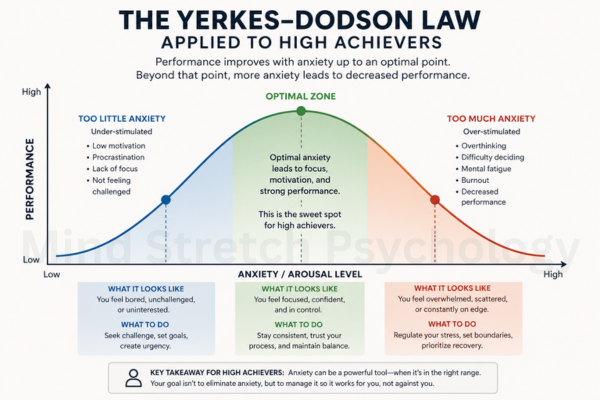
The Yerkes-Dodson Law describes how anxiety and performance are connected. As anxiety increases, performance improves up to an optimal point. Once anxiety exceeds that point, performance begins to decline. More recent research continues to support this relationship between stress and cognitive functioning, particularly in high demand environments (Sapolsky, 2015).
For a high achiever, this means there is a specific range where anxiety improves focus, motivation, and efficiency. Below that range, you may feel disengaged or unfocused. Above that range, anxiety begins to interfere with decision making and concentration. It can help to start identifying when your anxiety feels helpful versus when it starts to feel overwhelming.
Why High Achievers Use Anxiety to Improve Performance
In demanding careers like law, consulting, medicine, and graduate school, anxiety often becomes part of how you perform. It creates urgency, increases attention to detail, and pushes you to prepare more thoroughly. Research shows that moderate stress can enhance attention and working memory, which reinforces why anxiety feels useful in high pressure settings (Shields et al., 2017).
For many high achievers, performance is closely tied to identity. Anxiety becomes a way to maintain control and avoid mistakes.
When Anxiety Starts Hurting Performance in High Achievers
The Yerkes-Dodson Law highlights a critical shift. When anxiety becomes too high, it stops improving performance and begins to impair it. Chronic or intense stress can reduce cognitive flexibility, impair decision making, and increase mental fatigue.You may notice working longer hours with less output, second guessing decisions, difficulty concentrating, or feeling mentally and physically exhausted. If you want a clearer understanding of these patterns, you can read more about how anxiety is affecting your performance as a high achiever.
How High Achievers Can Stay in Their Optimal Performance Zone
Managing anxiety effectively allows you to maintain strong performance without constant strain. Start by tracking when your focus feels strongest during the day. Build structured breaks into your schedule to regulate stress levels. Set time limits for decisions to reduce overthinking. Begin separating your self-worth from your output so anxiety does not become your primary driver.
If you are starting to question whether this is something you can manage on your own, it may help to explore how to know if you need therapy as a high achiever.
Therapy for High Achievers with Anxiety in Washington DC, Utah, and all PSYPACT states
Therapy can help high achievers in Utah, Washington DC, and across PSYPACT states understand how anxiety affects performance and how to stay within an optimal range. You can improve decision making, maintain consistent work performance, and experience greater mental clarity. Therapy also helps reduce emotional and physical stress so you can perform at a high level without feeling overwhelmed.
Follow these three simple steps to get started:
Schedule a free 15 minute consultation to see if anxiety therapy is right for you.
Start coping with your stress as a high achiever.
Other Services Offered at Mind Stretch Psychology
At Mind Stretch Psychology we want to help you thrive. In addition to helping you manage anxiety and improve performance as a high achiever, we also offer services for those navigating perfectionism, trauma, expat and TCK experiences, and more.
References
Arnsten, A. F. T. (2009). Stress signalling pathways that impair prefrontal cortex structure and function. Nature Reviews Neuroscience, 10(6), 410–422. https://doi.org/10.1038/nrn2648
Arnsten, A. F. T. (2015). Stress weakens prefrontal networks: Molecular insults to higher cognition. Nature Neuroscience, 18(10), 1376–1385. https://doi.org/10.1038/nn.4087
Arnsten, A. F. T. (2020). Stress weakens prefrontal networks: Molecular insults to higher cognition. Nature Reviews Neuroscience, 21(10), 1–14.
Diamond, D. M., Campbell, A. M., Park, C. R., Halonen, J., & Zoladz, P. R. (2007). The temporal dynamics model of emotional memory processing: A synthesis on the neurobiological basis of stress-induced amnesia, flashbulb, and traumatic memories. Neural Plasticity, 2007, 60803. https://doi.org/10.1155/2007/60803
Lupien, S. J., Maheu, F., Tu, M., Fiocco, A., & Schramek, T. E. (2007). The effects of stress and stress hormones on human cognition: Implications for the field of brain and cognition. Brain and Cognition, 65(3), 209–237. https://doi.org/10.1016/j.bandc.2007.02.007
Sapolsky, R. M. (2015). Stress and the brain: Individual variability and the inverted U. Nature Neuroscience, 18(10), 1344–1346.
Shields, G. S., Sazma, M. A., & Yonelinas, A. P. (2017). The effects of acute stress on core executive functions: A meta-analysis. Psychological Bulletin, 143(6), 636–675.
Teigen, K. H. (1994). Yerkes-Dodson: A law for all seasons. Theory & Psychology, 4(4), 525–547. https://doi.org/10.1177/0959354394044004
Yerkes, R. M., & Dodson, J. D. (1908). The relation of strength of stimulus to rapidity of habit-formation. Journal of Comparative Neurology and Psychology, 18(5), 459–482. https://doi.org/10.1002/cne.920180503